 Perfect Septem
Why Were There Two Burial Cloths? The Sudarium of Oviedo and the Shroud of Turin
Researchers studying the Sudarium of Oviedo believe it may help explain why Saint John's Gospel describes two separate burial cloths associated with Jesus.
One of the lesser-known details in the Gospel accounts of Christ's burial appears in Saint John's description of the empty tomb. When Peter and the Beloved Disciple entered the tomb on Easter morning, they found not only the linen burial cloths, but also a separate cloth that had covered Jesus' head.
"Then Simon Peter came along behind him and went straight into the tomb. He saw the strips of linen lying there, as well as the cloth that had been wrapped around Jesus’ head. The cloth was still lying in its place, separate from the linen."
— John 20:6-7
For centuries, this detail may have seemed insignificant. Yet researchers studying an ancient relic known as the Sudarium of Oviedo believe it may provide remarkable insight into why two separate cloths were used.
What Is the Sudarium of Oviedo?
In the presentation Mark Guscin – Sudarium of Oviedo, hosted by Shroud Encounter, researchers examine a bloodstained cloth preserved in Oviedo, Spain, that has long been venerated as the head cloth mentioned in Saint John's Gospel.
The Sudarium is covered with bloodstains and bodily fluid patterns that shows it was produced by a deceased man who had suffered severe facial injuries and respiratory distress.
According to the research, the cloth was placed over the head of the deceased shortly after death. Its purpose was practical: to absorb blood and fluids emerging from the nose and mouth before the body was wrapped in a larger burial cloth.
This would explain why two separate cloths are described in the Gospel account—a head cloth and a burial shroud.
What Can the Stains Tell Us?
One of the most fascinating aspects of the Sudarium is that its stains can be scientifically analysed.
Under controlled laboratory conditions, researchers have attempted to recreate the patterns visible on the cloth. By studying how blood and bodily fluids behave, they can determine how the stains were formed and how the cloth was positioned around the head. The same patterns of blood and bodily fluid stains can be reproduced on the same spots repeatedly.
According to these studies, the stain patterns tell a story of movement. It reveals how the body was transported after death, including changes in position as it was carried from the place of crucifixion toward a burial site.
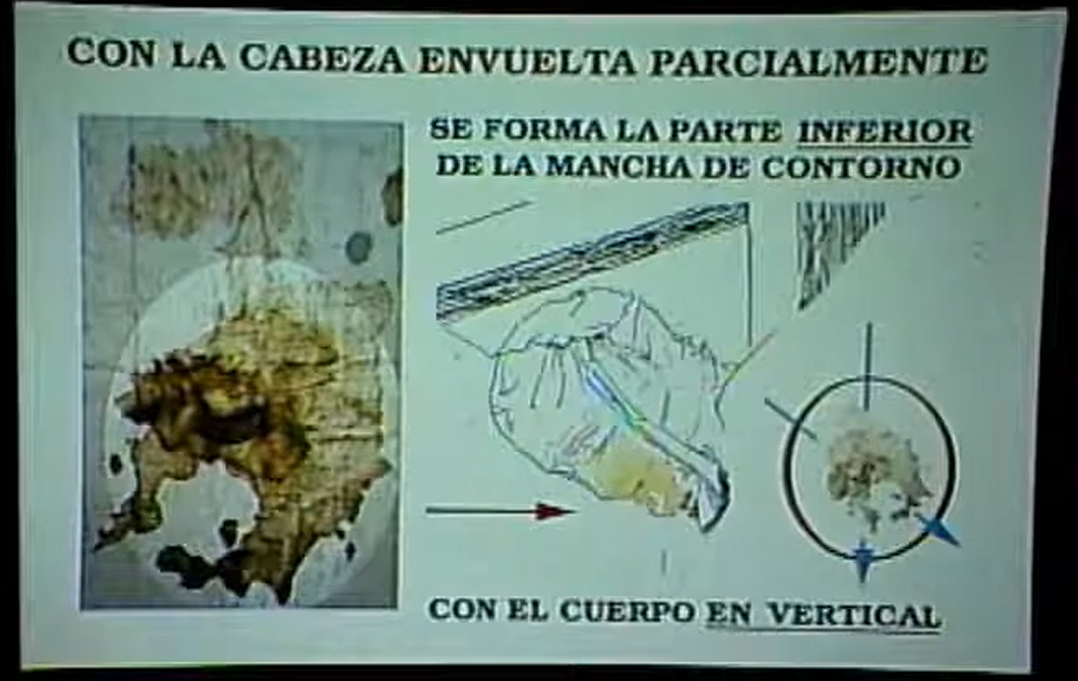
The stain formations are consistent with a man who had a beard, based on the way fluids interacted with facial hair.
A Remarkable Connection to the Shroud of Turin
Perhaps the most intriguing finding is the relationship between the Sudarium of Oviedo and the Shroud of Turin.
Researchers have noted that the bloodstain patterns on both cloths appear to correspond to the same facial wounds and positions. When the two cloths are compared, many of the stain locations align in a way that suggests they likely have covered the same individual at different stages of burial preparation.
In addition, studies have reported similarities in the blood characteristics found on both relics, including the same blood group classification.
The similarities are difficult to dismiss as mere coincidence.
Following the Trail Through History
The story does not end with the stains.
Researchers have also examined pollen traces and historical records associated with the Sudarium. Together, they believe these clues provide evidence for a journey that began in the Holy Land and eventually led to northern Spain.
Why It Matters
The Sudarium of Oviedo is often overshadowed by the more famous Shroud of Turin. Yet many researchers believe it may provide one of the strongest pieces of corroborating evidence in the study of Christ's burial cloths.
Whether viewed through the lens of faith, history, or science, the Sudarium of Oviedo presents an intriguing question:
Could the two cloths described by Saint John still exist today?
Watch the Full Presentation
You can watch Mark Guscin's presentation on the Sudarium of Oviedo here: